I totally get why monsteras are so popular . Who would n’t completely shine for a industrial plant that is n’t give-up the ghost to let down you , by gradually turn into a wilted heap of foliation in a Mary Jane ?
But minimal care requirements alone do n’t quite rationalize it . You also have to be beautiful to make it in the houseplant world .
And Swiss cheese plants have that covered with no trouble – the foliation take a crap you feel like you ’re living in a dreamy tropical forest somewhere distant and peaceful .

Photo by Kristine Lofgren.
We link to vendors to help you find relevant products . If you grease one’s palms from one of our links , we may pull in a commission .
Now , having sung the praises of this gem , I ’ve noticed that it is n’t always grown to its full potential .
There are times when it looks downright sad , falling over the edges of sens and tangling up in a big mess .

Do you cognise what fixture that ? Moss poles .
If you want your monstera to look as skillful and develop as vibrantly as potential , a moss pole is n’t just a opulence , it ’s a requirement .
Here are all the detail on the how and why to use these unparalleled houseplant - growing tools :

What You’ll Learn
What Is a Moss Pole ?
benefit of Moss Poles
Create Your Own Moss Pole

confiscate Your flora
criminal maintenance
Monsteras are super easy to grow on a support structure . In fact , it ’s better for them .

I know you often see them growing in an upright riding habit , but as they raise larger , you ’ll find that these are actually vining plants .
They ’ll start to look ungovernable and floppy without something to rise up .
These vining epiphytes have aerial stem that come in out of the stem turn above the ground level , and these are just looking for a stead to knock off on to .
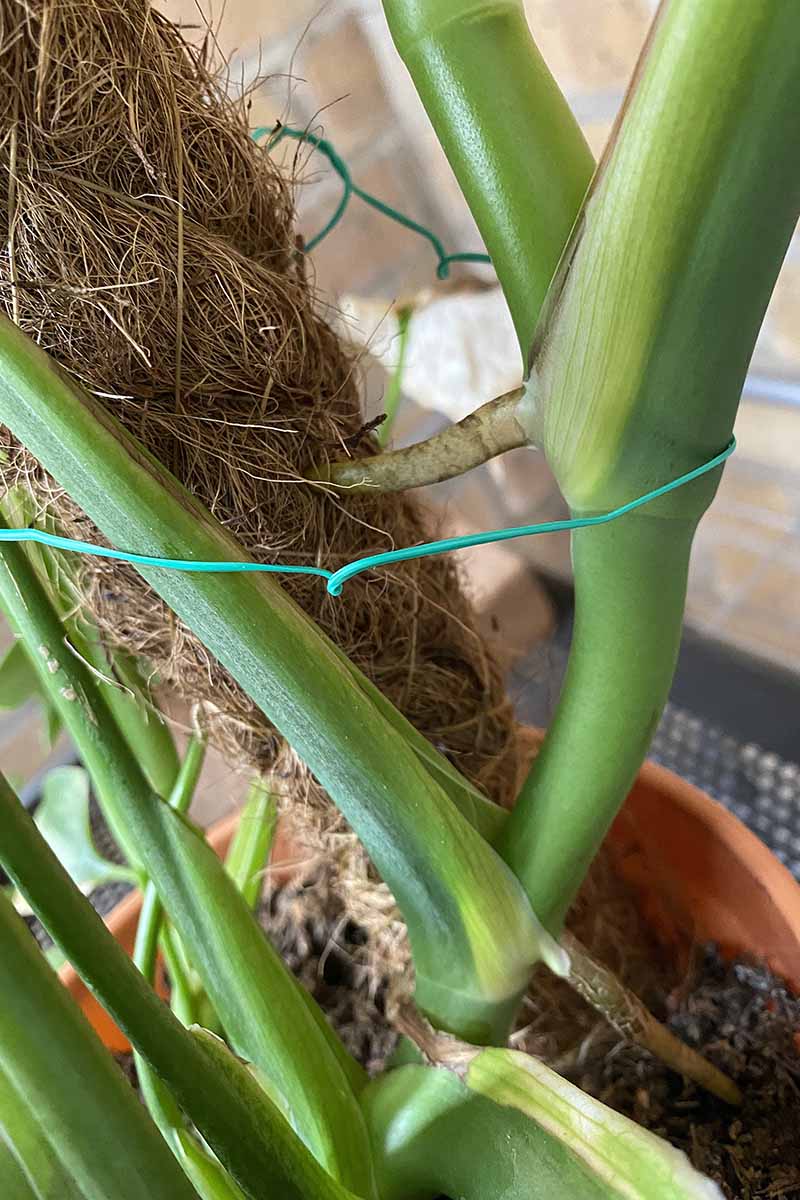
If you do n’t have a structure available for them to grow on , these origin will just kind of hang out , doing their thing .
But we can improve upon that , and help Swiss high mallow plant to fly high . A moss pole kind of acts like a trellis for these indoor specimens .
A moss pole is precisely what it sounds like . It ’s a solid structure covered in moss , usually sphagnum moss , that gardeners apply to grow their plants upwards rather than out .

Some of these are waxy so you could make interesting shapes , and others are satisfying .
Most have a smaller piece at the bottom to insert into the grease , and they total in a range of diameter and heights .
Monsteras areepiphytes , which are plants that grow in the nook and branches of trees and Dubyuh .

To be more specific , they areviningepiphytes , so they climb up and along fore and branches of other plants in the natural state .
They are n’t parasites , obtaining their water and nutrient from the air and dirt that collect around them instead of from their hosts .
This kind of bread and butter bodily structure somewhat recreates the raw environment that they favor , pass on the plant a place to anchor those aerial antecedent and go up off . It also allow for an extra source of nutrients and moisture .

Using one usually lead in a healthier specimen . And a healthier monstera produces larger leaves and more fenestration , which we love – correct ?
Plus , it just look tidier . Monsteras can start to search boisterous if you do n’t give them something to mount .
You do n’t need to put up a moss pole for young plant . They do n’t need it .

you may put one in plaza for future development , but most gardeners hold back until the industrial plant has started to send out multiple vining branches that weep over the side of the pot .
quick to get depart ? You canbuy one of these structures , in a variety of build and size . But they ’re pretty easygoing to create at home if you ’re crafty .
You ’ll demand a stick or pole , some sphagnum moss , and thin conducting wire or fishing personal credit line . I ’ve always used thick branches pull in from my railyard to make mine , but it ’s worth note that these will of course of instruction disintegrate over metre .

you may also habituate PVC organ pipe , wooden dowel pin , or even metal pipe .
To choose the best size , keep the current as well as the eventual size of it of your specimen in psyche . you’re able to always upgrade the size as your plant acquire – but it ’s a pain in the you - have a go at it - what .
It ’s become to be a lot easier to pick something larger than what you involve presently so you could keep it in place .

The depth and height are more important than the diam of the perch . The rod should extend at least a few inches taller than your plant , or you could beak something about the size of average mature altitude .
You ’ll want to insert about a quarter of the total duration of the perch in the substratum as well , so be certain to include that and make your calculations accordingly .
Soak your moss in water for 10 transactions or so and then wring it out well .
set about at least six inch up from the foundation , wrap a handful of moss around the rod and secure it in place with some wire or sportfishing line . Keep working your way up the rod , attach the moss and securing it as you go .
You want at least a half - column inch thickness of moss all the way of life around , but a chummy layer is even good . You want the roots to be capable to ground in there really well .
Whether you buy or make your rod , the process is the same for attaching your plant .
If your monstera is a tiny specimen in a little credit card pot , you belike do n’t demand a moss perch just yet .
set one in place so it ’s ready when you need it may sound like a honest estimation , but commend that you do n’t want to bung the pot over , and you may run into want a necessary size upgrade later .
While we ’re discussing sturdiness , do n’t forget that you demand a reasonably substantial pot to start with if you plan to train your ceriman to grow upwards .
If it ’s weep over the sides of the pot , you do n’t need quite as much weight at the bottom .
But once you ’re growing tall , system of weights at the bottom is necessary to balance the weight of the add meridian . A lightweight plastic pot is going to tip right over the first sentence someone bump it .
Choose Lucius Clay or concrete just to be secure if you have a large plant .
I ’m also a bountiful fan of the kind of container stands that provide support to the side of the grass , like this one by Mkono that’savailable on Amazon . Plus , they just look nerveless , right ?
Mkono Houseplant Stand
Secure the specimen to the pole by mildly tuck the aerial roots into the moss covering the support , and fasten the leaf with garden mag tape or twine .
Do n’t use fishing contrast or wire as it will cut into the shape of the stem .
If you regain the moss to be too compacted , you could drizzle it to aid plump it up , or just wait and tie the aerial roots to the string and skip tuck it into the moss .
you may attach the petiole of the leaves if you postulate to , but it ’s better to attach them at the internode .
The petiole is the stem that extends from the leaf and attaches to the stem . The internodes are the parts of the stem between the leave of absence .
As the plant life grow , you’re able to help oneself it out by attaching Modern growth to the support . Those aerial theme might do some gripping of their own , but you ’ll probably need to give them an assist sporadically .
If you let the sphagnum moss get too dry it will be difficult to plump it back up . Plus , juiceless moss means the aerial roots are drying out too .
Since aerial roots just provide supplemental water system , it is n’t the ending of the world , but we always want to examine to make our plants as felicitous as possible , ripe ?
Dryness wo n’t vote out your Swiss Malva sylvestris plant , but it ’s healthier for the root if you keep the moss moist without oversaturating it .
Either drip water down the length of the support from the top or spritz it with a spray bottleful when it starts to feel ironical to the sense of touch .
If , for some rationality , you need to remove your plant from the terminal , cautiously take away any twine or magnetic tape and then make out off the airy roots that are feeding into the moss .
These should be abbreviate off completely as close to the theme as possible . Your plant life ’s growth will likely be stunt for a time , but it should go back .
Level Up Your Monsteras
It ’s a sign of success if you need to give your Swiss cheese plant a moss pole to climb up up on . It intend that it has grown magnanimous enough that it need something to confirm all that luscious growth . dainty study !
These houseplant gardening tools are n’t as common as , say , bamboo pole . But as more and more indoor gardeners learn how to make epiphytes thrive , they ’re popping up in more homes .
That ’s first-class because they make your specimen not only look better , but grow healthier as well . They better airwave circulation , make economic consumption of aeriform roots , and put your works in a more raw locating .
How long have you been growing your Swiss tall mallow plant ? Did you prefer to add a terminal from the start , or did you rule you wanted to add one as your plant grow vainglorious and luscious ? Tell us all about it in the scuttlebutt section , and do n’t bury to share your photos !
And for moreinformation about growing and caring for ceriman , check out these guide next :
picture by Kristine Lofgren © require the Experts , LLC . ALL right field RESERVED.See our TOSfor more detail . Product photo via Mkono . Uncredited pic : Shutterstock .
About
Kristine Lofgren
