perennial > ECHINOPS
IN THIS templet
ECHINOPS GUIDES

The blue or snowy ball-shaped blossom heads of Echinops can land a gumption of the Mediterranean to a garden .
Also known as ‘ Globe Thistles ’ , these are plants that can tally in alongside many other Mediterranean plants in a sunlight - kissed part of a garden .
genus Echinops grown in UK gardens are usually herbaceous perennials that will leave large value in a garden outer space over a identification number of years .

E. ‘Taplow Blue’
Most have prime held in circular heads with a violet - blue hue , while some cultivars have white flowers .
Overview
PreferredFull sun or partial shade
ExposureExposed or shelter
Height1 – 1.5 M

Spread0.5 – 1 metre
Bloom TimeJuly to August
PreferredLoam , sand , remains
MoistureMoist but well - drained or well - run out
pHAny
genus Echinops largely get from Southeastern Europe , though their native range also spreads into Asia and some are also found in mountains of tropical Africa too.1Echinops ritro . ( 2021 , August 4 ) . Cambridge Botanic Garden . Retrieved July 5 , 2023 , fromhttps://www.botanic.cam.ac.uk/the-garden/plant-list/echinops-ritro/
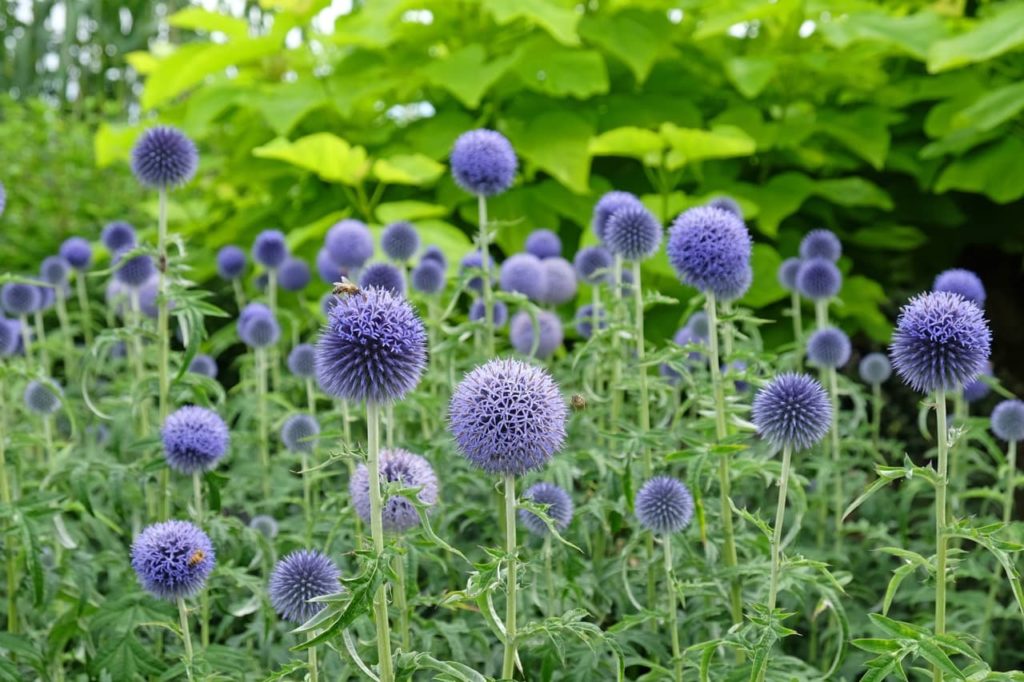
E. ‘Taplow Blue’
Their common name , ‘ Globe Thistle ’ , come from their spinous foliation , but though they are called globe thistles , they are not closely related to the true thistle coinage .
The name Echinops comes from the Greek for a hedgehog.2All About Echinops . ( 2022 , July 28 ) . Retrieved July 5 , 2023 , fromhttps://www.americanmeadows.com/perennials/unique-perennials/all-about-echinops
These plants are prized in garden for their flowers and their height .

They pair well with a range of othercommon plants in bungalow garden , crushed rock garden for down in the mouth - water areas , wildlife gardens hone for pollinatorsand plenty of other flower bed and boundary line .
They are a good selection for promiscuous , organic , prairie planting alongside other herbaceous perennials and ornamental skunk , but also work well in much more conventional and neat planting schemes .
How To Grow Echinops
Echinops is relatively easy to grow as long as you pay attention to its canonic need .
When put and care for correctly , this plant can for sure make for a great option for a abject - care space .
As perennials , they should remain in place and get back each twelvemonth over multiple old age and these flora can also self - ejaculate readily in a location where they are well-chosen to grow .
genus Echinops seeds should be inseminate in March or April .
They can be sown indoors in pots or seed trays or in a well - prepare seedbed outside .
you’re able to also directly sow the seeds where they are to develop if the condition are suitable in your garden .
Some gardeners also sow in the autumn , but in my feeling , sow in spring in the UK by and large gives better solvent .
If seed indoors , transplant the Echinops to the garden after the last frosts where you subsist .
Above all else , when choosing a location in which to grow Echinops , remember that , though hardy , it derive from southern Europe and likes Mediterranean term .

That means planting it in full sun or light shade will get the expert issue .
There are not really particularly hard and fast rule when it comes to spacing Echinops , though generally seedlings are placed around 30 cm apart .
This may vary a niggling depending on which variety or variety of Echinops you have pick out to grow .

genus Echinops need moist but free - draining or loose - drain soil and will do best in moderately miserable soil which debilitate very freely .
ensure that you dig out a generous planting yap for the plants you wish to place in your garden and where the soil is not as free draining , add grit to ensure that waterlogged condition do not get up .
uprise Echinops in your garden and you will soon notice that they are surrounded by bees , butterflies and other pollinators throughout their flowering period .

“ Echinops are a capital flora for pollinators , ” states Master Horticulturist Colin Skelly .
“ Regardless of the cultivar , they are always handle in a compass of pollinating insects , persisting into early fall in most region of the UK . ”
These flowers are not aboriginal , but they do appeal and provide pollen and nectar for a broad scope of our aboriginal insect aliveness .

While it is always a great melodic theme to admit a gamey proportionality of native flower in your garden for the bee and other wildlife , coalesce in some non - natives ( include Echinops ) is not a bad idea and can simply add to the biodiversity within the garden .
Echinops Care
Once established , Echinops growing in a location that provides the right growing condition loosely will not require a great deal of concern .
However , there are some key elements to deal .
One crucial element of care is watering .
genus Echinops should be watered in well and water during keep up dry spells , especially as they become establish .
Once set up , however , these are jolly drought - tolerant plants .
In fact , they can cope much better with dry conditions than they can with too wet situations , so take care not to overwater your plant .
Another of the jobs to do when raise genus Echinops is to cut them back after the first blooms have languish .
This is not only to tidy up the garden but also can sometimes boost a further flush of blooms to break .
If the works clumps become too congested , you’re able to lift and divide them to propagate new works and give the existing plant a newfangled lease of lifespan .
One of the most common problems when growing Echinops , which are broadly difficulty - free and not prone to many pests or disease , is an aphid infestation .
Aphids should be welcomed in an constitutional garden along with their predator who will keep their numbers in check and the ecosystem in balance .
In a goodish , constitutive and biodiverse garden , aphids will seldom get out of control and wo n’t typically pose a major terror to your Echinops or to other plantings .
In terms of environmental problem , wretched drainage is perhaps the thing that most commonly derails successful Echinops growing .
Making certain that there is adequate drain in the earth or in container is one of the most important things when growing these plants .
Container Growing
you may grow Echinops in lot and they can be good candidate for a container garden .
Smaller , shorter cultivar might loosely be consider better option for pots but any cultivar should be fine either on their own or with other plant that similarly like cheery and gratis - debilitate conditions .
When choosing a container , check that that it is sturdy enough to stand up and not tippytoe over when grow improbable cultivars .
A terracotta or Lucius Clay pot can be idealistic because it will not retain water as much as a plastic one .
check that it allows water to drain out freely at the groundwork so that waterlogging can not occur .
fill up your chosen container with a suitable peat - free growing medium with added grit or sand to improve drain .
A territory - ground selection is best for perennials that will persist in their pots over multiple years .
Note that in pots , as in the garden , Echinops that are taller may require staking or some support , specially if they are grown in a somewhat tedious location .
Common Varieties
Some vernacular varieties of globe thistle to consider grow in your garden are :
